
A 67-million-year-old Tyrannosaurus rex is heading to Britain for the first time, as Portsmouth prepares to welcome one of the most remarkable dinosaur skeletons ever assembled
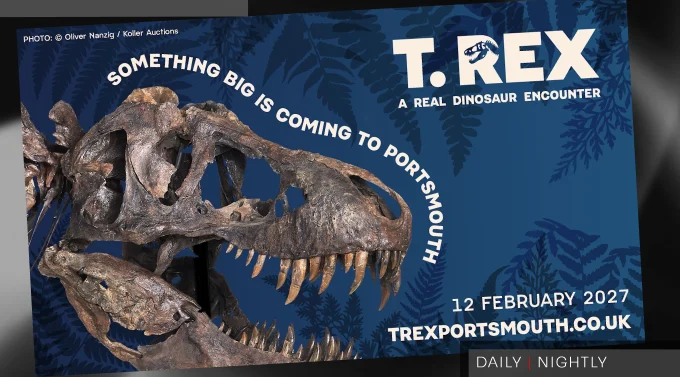
Trinity, an extraordinary specimen comprising 293 genuine fossil bones, will make her UK public debut at Portsmouth Historic Dockyard on Friday 12 February 2027, offering visitors the opportunity to come face-to-face with one of prehistory’s most formidable predators.
Tickets went on sale on Friday 20 November for the new interactive exhibition, which will occupy a specially transformed Grade II-listed building at the historic dockyard.
Measuring 11.6 metres in length – longer than a double-decker bus – and standing more than four metres tall, Trinity is an imposing sight. Her bite would have been powerful enough to crunch through a car, while her estimated weight of more than ten tonnes would have made her heavier than two Indian elephants.
The British arrival was announced on Thursday 19 November at Portsmouth Historic Dockyard, where a spectacular interactive light installation was projected onto historic Boathouse 4. The dramatic reveal formed part of We Shine Portsmouth, the city’s light festival, which runs until today (Saturday 21 November.)
The announcement was accompanied by a suitably colourful observation from lead palaeontologist Dr Nizar Ibrahim, who joked that although the Bayeux Tapestry may be approaching its 1,000th birthday, Trinity would have it for breakfast.
Why Portsmouth?
A dinosaur attraction of this international significance might traditionally be expected to find a home at one of London’s major museums. However, Portsmouth has a particularly strong connection to Britain’s prehistoric past.
Just across the Solent lies the Isle of Wight, internationally recognised as one of Europe’s richest locations for dinosaur fossils. Meanwhile, researchers at the University of Portsmouth have played an important role in identifying previously unknown species and advancing the understanding of prehistoric life.
Hannah Prowse, CEO of Portsmouth Historic Quarter, believes the city is the natural home for Trinity’s British debut.
“You might expect a T. rex of this significance to end up at the Natural History Museum or the British Museum in London. But when you look at where dinosaur discovery is happening in Britain, Portsmouth makes perfect sense,” she said.
“Across the Solent is the Isle of Wight, one of Europe’s richest fossil sites, and here in Portsmouth we have scientists whose work is changing what we know about prehistoric life. This is exactly where Trinity belongs.
“Portsmouth Historic Dockyard is already a place where people encounter the real evidence of the past, from the Mary Rose to HMS Victory. Trinity takes that experience back 67 million years. We’re proud to bring a world-class exhibition beyond London, one that combines genuine fossils, live scientific research and the chance for people of all ages to feel the scale of a T. rex for themselves.”
A £1.5 million transformation of Boathouse 5 will create a spectacular temporary home for the dinosaur, with an immersive and accessible visitor experience charting Trinity’s journey from prehistoric animal to fossil discovery and ongoing scientific investigation.
A remarkable collection of genuine fossils
Trinity is assembled from 293 genuine fossil bones belonging to three Tyrannosaurus rex specimens of comparable size, quality and geological origin. The individual animals were discovered in the United States between 1995 and 2013.
Combining bones from more than one specimen is a recognised practice in mounting dinosaur skeletons, as individual fossil discoveries are rarely complete. Trinity’s name reflects the three animals represented in the assembled skeleton.
Following an auction sale in 2023 for more than $6 million, the skeleton was acquired by The Phoebus Foundation, a public-benefit art foundation based in Antwerp, Belgium.
Rather than being confined to a private collection, Trinity has been made accessible through international exhibitions and scientific research. She has previously been displayed in Switzerland and Denmark, but her forthcoming Portsmouth appearance will be her first time on British soil.
Her arrival also comes amid growing debate about the escalating value of dinosaur fossils and concerns that scientifically significant discoveries could become inaccessible to researchers and the wider public. The Foundation’s approach aims to keep Trinity available for public exhibition while allowing scientists to continue studying her remains.
What can Trinity tell us about the age of dinosaurs?
Beyond the spectacle of seeing a full-sized Tyrannosaurus rex, the Portsmouth exhibition will provide an opportunity to discover what her bones can reveal about life 67 million years ago.
An ongoing research programme will be led by internationally renowned palaeontologist and National Geographic Explorer Dr Nizar Ibrahim, working alongside PhD researchers from the University of Portsmouth.
The team will investigate the anatomy of the animals represented in the skeleton, examining evidence of growth, age, injuries and disease preserved in the fossilised bones. Their findings could help provide a greater understanding of how these enormous predators developed, moved and survived.
Dr Ibrahim, Scientific Director of Dinosaur Museum Bavaria (Dinosauriermuseum Altmühltal), said: “Tyrannosaurus rex may be the most recognisable dinosaur on Earth, but there is still an enormous amount we can learn about these extraordinary animals. Trinity gives us the opportunity to investigate evidence of growth, movement, injury, disease and survival and to move beyond the image of T-Rex simply as a giant predator.
“Visitors will be encountering genuine fossils while that investigation is still continuing. The bones are the beginning of the story, not the end: they can help us understand what these animals experienced and what their lives were really like 67 million years ago – in the age of the dinosaur.”
Dr Ibrahim brought the project and skeleton to Portsmouth during his tenure at the university. His research into major predatory dinosaurs, including Spinosaurus, has featured in National Geographic and the BBC’s Walking with Dinosaurs.
Trinity’s story, it seems, is far from over. Although her life ended 67 million years ago, the fossilised remains continue to offer opportunities for discovery, with visitors able to follow the scientific investigation as it develops.
The Trinity T. rex exhibition opens at Portsmouth Historic Dockyard on Friday 12 February 2027. Tickets are on sale now at www.trexportsmouth.co.uk.