
Why Sinkholes Collapse explores the dramatic road collapse outside a Bangkok hospital and uncovers the hidden dangers lurking beneath towns and cities around the world
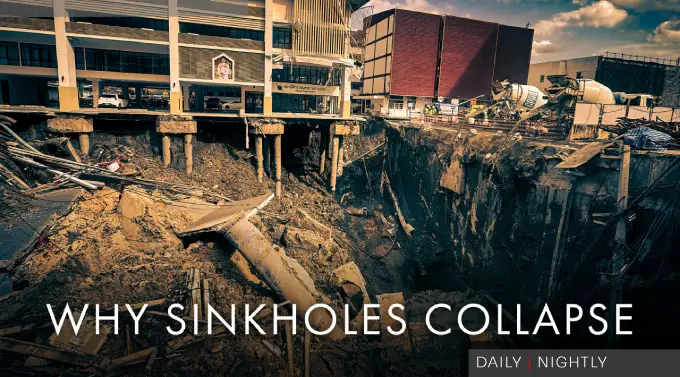
A dramatic sinkhole that swallowed part of a Bangkok road, two vehicles and threatened a nearby hospital is at the centre of a new BBC Two documentary investigating why the ground beneath our cities is increasingly giving way.
Why Sinkholes Collapse examines the events of 24 September 2025, when a huge crater measuring 30 metres wide and 20 metres deep suddenly opened outside Bangkok’s Vajira Hospital. Water pipes were snapped, power lines brought down and the hospital’s foundations put at risk, forcing almost 1,000 staff and patients to evacuate. Miraculously, nobody was killed or injured.
The programme features extraordinary footage of the hole continuing to grow, swallowing a tow truck and a police car. Major Ratchawith Sitthichok of Bangkok Traffic Police recalls how both vehicles, including his own, ended up in the crater. Witnesses Ampan Vimonvattana and nearby food-stall owner Duangduen Pum-in also describe the terrifying collapse.
As the ground continues to give way, Bangkok Fire and Rescue’s Thianwit Phisutthipakorn abseils into the hole in an attempt to recover a vehicle, only to narrowly escape when another collapse sends soil sliding towards him.
But Bangkok is far from the only place facing the threat. The documentary travels to Ripon in North Yorkshire, where underground gypsum deposits can dissolve to form caves. When their roofs collapse, the damage can eventually reach the surface.
Investigators in Bangkok suspect a damaged tunnel serving a newly built underground railway contributed to the disaster, allowing soil to pour into the tunnel and an adjacent station still under construction. However, the precise cause remains uncertain, with groundwater levels also among the possible factors.
The film also examines a deadly road collapse in Yashio City, Japan, in January 2025, when a corroded sewer pipe caused the road to give way, killing a 74-year-old lorry driver. His vehicle’s cab was swept 30 metres down the pipe, and it took three months for authorities to recover his body.
Closer to home, a huge sinkhole appeared on Godstone High Street in Surrey in February 2025. Investigations uncovered previously unmapped Victorian sand mines beneath the road. David White, a highways engineer at Surrey County Council, explains how engineers are stabilising the underground workings using grout to create supporting pillars and fill empty spaces.
From abandoned mines beneath Paris to hundreds of sinkholes appearing in Turkey’s Konya basin as groundwater is pumped away for farming, the programme explores the many ways the ground can become unstable.
It also looks at the challenge of maintaining the vast network of pipes and utilities beneath modern cities, with tunnelling and geotechnical engineer Anmol Bedi explaining how ageing infrastructure can contribute to sudden collapses.
New technology is also offering potential solutions, including specialist drones used by UK water companies to inspect sewers more quickly, safely and cheaply.
Why Sinkholes Collapse airs at 9pm on Thursday 26 November on BBC Two